An AI-driven pose app that shows you the right pose for your body, your outfit, your moment — and never touches your photos. Designed solo, end-to-end, through four Lean UX iterations.
On Instagram and TikTok, photography became identity work — and for a lot of people, that's where the anxiety starts. You open the camera and freeze. You don't know what to do with your hands. You copy a pose from Pinterest and it looks nothing like it did on the model, because their body, outfit, and confidence aren't yours.
The tools that exist don't help. Influencer tutorials and filter apps sell one narrow, idealised look. They rarely represent different body types, cultural dress, or ability — so the people who most need reassurance are the ones the references exclude.
"I try poses from Pinterest, but copying often feels awkward. Afterwards, I usually regret it."
— Participant, user interviewThat gap set two research questions:
The challenge was validating whether personalisation itself builds confidence — before any AI model exists to power it.
10 user + 2 expert interviews, secondary research, competitor analysis, affinity mapping.
Assumptions → hypotheses (Gothelf prioritisation) → IA → Lo-Fi → Hi-Fi.
Moderated usability testing across 4 rounds, weighted task scoring, iteration.
All six hypotheses at 100% by Hi-Fi 2. Feedback shifted from problems to feature requests.
The decision that defined the product
My first instinct was the technically obvious one: a camera / AR overlay that traces poses onto you in real time. I killed it. The research was clear that the barrier was emotional before it was functional — asking a camera-shy person to point a live camera at themselves and upload images doesn't reduce the anxiety, it is the anxiety. I moved to an avatar-based model instead: no photos, no uploads, no comparison to a stranger's body.
Three principles came out of the research and guided every choice — from interaction logic to what I deliberately chose not to build.
Design fails at the feeling level before it fails at the usability level. The job was to reduce anxiety, not to produce a more "perfect" pose.
Every mention of camera analysis or photo storage raised a concern in research. So the whole system was built to work without a single uploaded image.
People want a friend, not a critic. Guidance is visual-first and reassuring, and every recommendation explains why — supportive, never corrective.
Ten semi-structured user interviews and two expert interviews, recruited across Instagram, Facebook, and WhatsApp for diversity in body type, gender expression, and cultural background. I synthesised them through affinity mapping into three insights that drove every design decision.
"I can see the pose rather than guessing… it feels like a friend giving a small boost."
— Participant, usability sessionPoseU is designed as an AI-driven product. It does not run a trained model, and I'm deliberately clear about that — because implying a live model exists falls apart the moment anyone technical asks a question. The honest version is the stronger one: the goal was to validate whether personalisation itself builds confidence and trust before any ML engineering exists. That's a de-risking move, not a shortcut — and it hands a future team a validated interaction model instead of a guess.
15 participants rated 12 AI-generated poses on a 7-point scale for confidence, comfort, and suitability. The results became the evidence behind the recommendation logic.
| Dimension | Strongest poses | Avg score | What it told the logic |
|---|---|---|---|
| Confidence | Power Posture · Striding Confidence · Tall Elegance | ~6.3 | Open, forward-facing posture reads as "empowering" — confidence comes from openness and balance, not exaggeration. |
| Comfort | Casual Natural Candid · Relaxed Beach Confidence | ~6.2 | Natural, candid poses feel "authentic" and "easy to do" — comfort comes from poses that look real, not staged. |
| Inclusivity | Graceful Saree Flow · Mirror Pose | ~6.2 | Varied body shapes, outfits, and skin tones raise perceived authenticity — inclusivity strengthens relatability. |
| Composition | Group Magazine Shoot | 6.4 | Highest overall — diverse group arrangements read as both aspirational and relatable. |
Three flows carry the whole experience — each designed to feel intuitive from the apps users already know, and to keep cognitive load low at the anxious moment.
The IA maps to five moments in the way users already think about preparing for a photo — so the experience feels intuitive rather than instructional, with privacy and reassurance built into the structure itself.
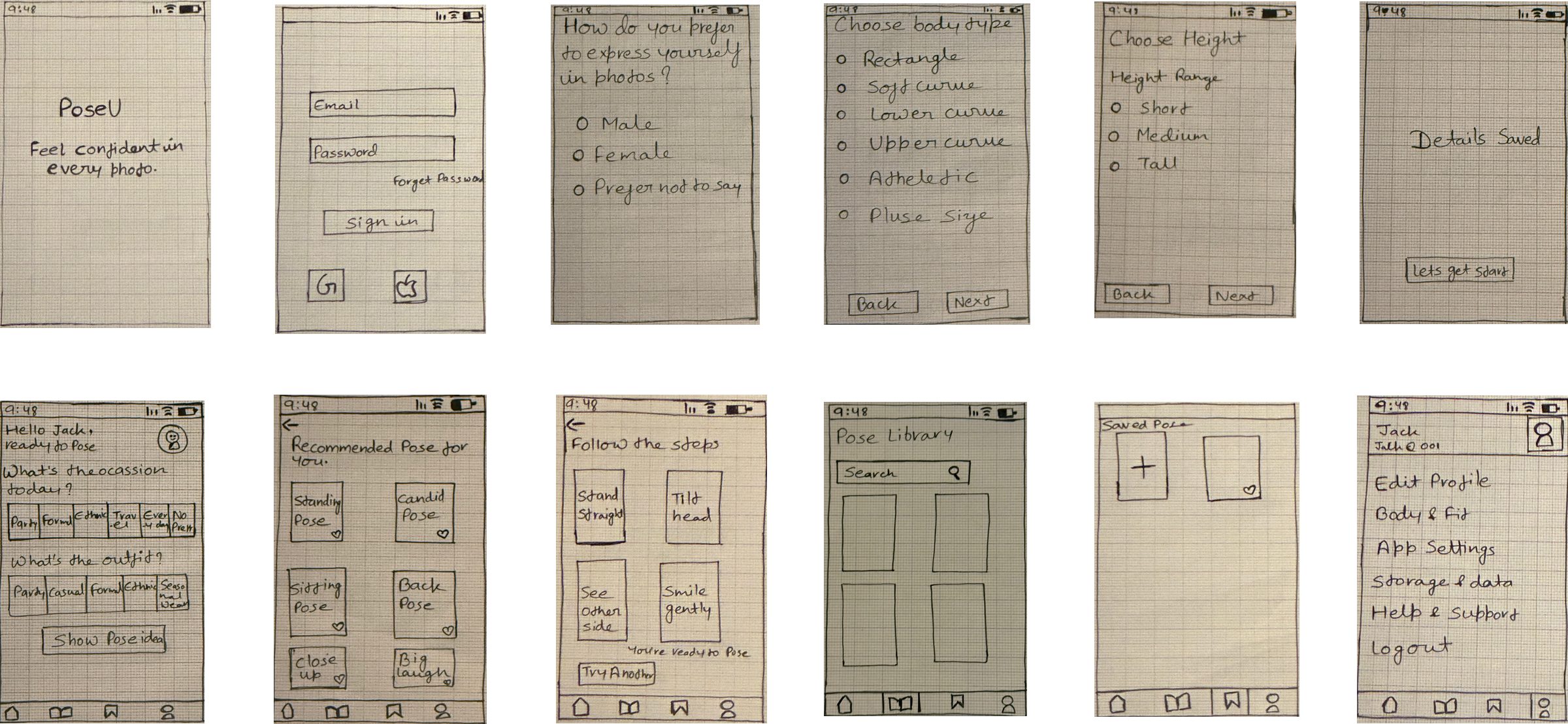
Two low-fidelity iterations validated the core proposition — step-based pose guidance without photo uploads — and confirmed input comprehension and the end-to-end journey before committing to visual design.
Two high-fidelity iterations tested tone, readability, and confidence under realistic conditions. Every decision traces back to a research theme, a survey result, or a failed prototype task.
Hi-Fi Iteration 1 surfaced three specific failures. Iteration 2 fixed exactly those — and moved every hypothesis. These aren't cosmetic tweaks; each one traces to a task users struggled with.
Most student case studies have one hero metric. PoseU has six independently tested hypotheses, all moving the same direction between high-fidelity rounds — each traceable to a specific design fix.
| Hypothesis | Focus | Hi-Fi 1 | Hi-Fi 2 |
|---|---|---|---|
| H1 | Personalised suggestions | 80% | 100% |
| H2 | Step-based guidance | 40% | 100% |
| H3 | Inclusive representation | 20% | 100% |
| H4 | Minimal UI & onboarding | 20% | 100% |
| H5 | Reassuring prompts | 40% | 100% |
| H6 | Privacy-first trust | 0% | 100% |
"PoseU taught me that design fails at the feeling level before it fails at the usability level — and that being honest about simulated AI is part of the evidence, not a caveat on it."
Every screen traces back to something a participant said, a survey result, or a task that failed in testing. The AI is simulated — and I'm honest about that. That honesty is the work.